

Tarantino
By Zain Aleshaiker

It is Tarantino's strategy in all of his films to have the characters speak at right angles to the action, or depart on flights of fancy. Remember the famous opening conversation between Jules and Vincent, who are on their way to a violent reprisal against some college kids who have offended Wallace and appropriated his famous briefcase. They talk about the drug laws in Amsterdam, what Quarter
Pounders are called in Paris, and the degree of sexual intimacy implied by a foot massage.
Finally Jules says "let's get in character,'' and they enter an apartment. Tarantino's dialogue
is not simply whimsical. There is a method behind it. The discussion of why Quarter Pounders
are called "Royales'' in Paris is reprised, a few minutes later, in a tense exchange between
Jules and one of the kids (Frank Whaley). And the story of how Marsellus had a man
thrown out of a fourth-floor window for giving his wife a foot massage turns out to be a set-up:
Tarantino is preparing the dramatic ground for a scene in which Vincent takes Mia Wallace
(Uma Thurman) out on a date, on his bosses' orders. When Mia accidentally overdoses,
Vincent races her to his drug dealer Lance (Eric Stoltz), who brings her back to life
with a shot of adrenaline into the heart.
Pulp Fiction is an outrageously violent, time-twisting, and in love with language, Pulp Fiction was widely considered the most influential American movie of the 1990s. Director and co-screenwriter Quentin Tarantino synthesized such seemingly disparate traditions as the syncopated language of David Mamet; the serious violence of American gangster movies, crime movies, and films noirs mixed up with the wacky violence of cartoons, video games, and Japanese animation; and the fragmented story-telling structures of such experimental classics as Citizen Kane, Rashomon, and La jetée. The Oscar-winning script by Tarantino and Roger Avary intertwines three stories, featuring Samuel L. Jackson and John Travolta, in the role that single-handedly reignited his career, as hit men who have philosophical interchanges on such topics as the French names for American fast food products; Bruce Willis as a boxer out of a 1940s B-movie; and such other stalwarts as Harvey Keitel, Tim Roth, Christopher Walken, Eric Stoltz, Ving Rhames, and Uma Thurman, whose dance sequence with Travolta proved an instant classic.

And that scene also begins with dialogue that seems like fun, while it's also laying more groundwork. We meet Lance's girlfriend Jody (Rosanna Arquette), who is pierced in every possible place and talks about her piercing fetish. Tarantino is setting up his payoff. When the needle goes into the heart, you'd expect that to be one of the most gruesome moments in the movie, but audiences, curiously, always laugh. In a shot-by-shot analysis at the University of Virginia, we found out why. QT never actually shows the needle entering the chest. He cuts away to a reaction shot in which everyone hovering over the victim springs back simultaneously as Mia leaps back to life. And then Jody says it was "trippy'' and we understand that, as a piercer, she has seen the ultimate piercing. The body language and the punchline take a grotesque scene and turn it into dark but genuine comedy. It's all in the dialogue and the editing. Also, of course, in the underlying desperation, set up by thoughts of what Marsellus might do to Vincent, since killing Mrs. Wallace is much worse than massaging her foot.


OVERALL
DIRECTION

But it isn't the structure that makes "Pulp Fiction'' a great film. Its greatness comes from its marriage of vividly original characters with a series of vivid and half-fanciful events and from the dialogue. The dialogue is the foundation of everything else.
The movie is all storytelling and no story. The motivations have no psychological depth or resonance, but are simply plot markers. The characters consist of their characteristics. Lurking beneath everything, as it did with "Pulp Fiction," is the suggestion of a parallel universe in which all of this makes sense in the same way that a superhero's origin story makes sense. There is a sequence here
(well, it's more like a third of the movie) where The Bride single-handedly wipes out O-Ren and
her entire team, including the Crazy 88 Fighters, and we are reminded of Neo fighting the
clones of Agent Smith in "The Matrix Reloaded," except the Crazy 88 Fighters are individual
human beings, I think. Do they get their name from the Crazy 88 blackjack games on the
Web, or from Episode 88 of the action anime "Tokyo Crazy Paradise," or should I seek help?
The Bride defeats the 88 superb fighters (plus various bodyguards and specialists) despite
her weakened state and recently paralyzed legs because she is a better fighter than all of the
others put together. Is that because of the level of her skill, the power of her focus, or the depth
of her need for vengeance? Skill, focus and need have nothing to do with it: She wins because
she kills everybody without getting killed herself. You can sense Tarantino grinning a little as each fresh victim, filled with foolish bravado, steps forward to be slaughtered. Someone has to win in a fight to the finish, and as far as the martial arts genre is concerned, it might as well be the heroine. (All of the major characters except Bill are women, the men having been emasculated right out of the picture.) "Kill Bill, Volume 1" is not the kind of movie that inspires discussion of the acting, but what Thurman, Fox and Liu accomplish here is arguably more difficult than playing the nuanced heroine of a Sundance thumb-sucker. There must be presence, physical grace, strength, personality and the ability to look serious while doing ridiculous things. The tone is set in an opening scene, where The Bride lies near death and a hand rubs at the blood on her cheek, which will not come off because it is clearly congealed makeup. This scene further benefits from being shot in black and white; for QT, all shots in a sense are references to other shots -- not particular shots from other movies, but archetypal shots in our collective moviegoing memories.
DIRECTION
Kill Bill shows Quentin Tarantino so effortlessly and brilliantly in command of his technique that he reminds me of a virtuoso violinist racing through "Flight of the Bumble Bee" -- or maybe an accordion prodigy setting a speed record for "Lady of Spain." I mean that as a sincere compliment. The movie is not about anything at all except the skill and humor of its making. It's kind of brilliant. His story is a distillation of the universe of martial arts movies, elevated to a trancelike mastery of the material. Tarantino is in the Zone. His story engine is revenge. In the opening scene, Bill kills all of the other members of a bridal party, and leaves The Bride (Uma Thurman) for dead. She survives for years in a coma and is awakened by a mosquito's buzz. Is QT thinking of Emily Dickinson, who heard a fly buzz when she died? I am reminded of Manny Farber's definition of the auteur theory: "A bunch of guys standing around trying to catch someone shoving art up into the crevices of dreck." The Bride is no Emily Dickinson. She reverses the paralysis in her legs by "focusing." Then she vows vengeance on the Deadly Viper Assassination Squad, and as "Volume 1" concludes, she is about half-finished. She has wiped out Vernita Green (Vivica A. Fox) and O-Ren Ishii (Lucy Liu), and in "Volume 2" will presumably kill Elle Driver (Daryl Hannah), Budd (Michael Madsen) and of course Bill (David Carradine). If you think I have given away plot details, you think there can be doubt about whether the heroine survives the first half of a two-part action movie, and should seek help.
OVERALL
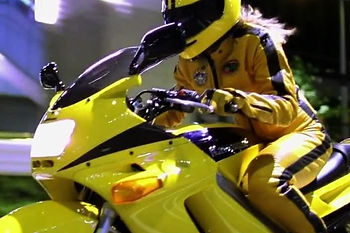

There's B&W in the movie, and slo-mo, and a name that's bleeped entirely for effect, and even an extended sequence in anime. The animated sequence, which gets us to Tokyo and supplies the backstory of O-Ren, is sneaky in the way it allows Tarantino to deal with material that might, in live action, seem too real for his stylized universe. It deals with a Mafia kingpin's pedophilia. The scene works in animated long shot; in live action closeup, it would get the movie an NC-17. By the same token, Thurman wears a costume identical to one Bruce Lee wore in his last film. Is this intended as coincidence, homage, impersonation? Not at all. It can be explained by quantum physics: The suit can be in two movies at the same time. And when the Hannah character whistles the theme from "Twisted Nerve" (1968), it's not meant to suggest she is a Hayley Mills fan but that leakage can occur between parallel universes in the movies. Will "Volume 2" reveal that Bud used to be known as Mr. Blonde?


OVERALL
Reservoir Dogs, the first from an obviously talented writer-director, is like an exercise in style. He sets up his characters during a funny scene in a coffee shop, and then puts them through a stickup that goes disastrously wrong. Most of the movie deals with its bloody aftermath, as they assemble in a warehouse and bleed and drool on one another. The movie has one of the best casts you could imagine, led by the legendary old tough guy Lawrence Tierney, who has been in and out of jail both on the screen and in real life. He is incapable of uttering a syllable that sounds inauthentic. Tierney plays Joe Cabot, an experienced criminal who has assembled a team of crooks for a big diamond heist. The key to his plan is that his associates don't know one another, and therefore can't squeal if they're caught. He names them off a color chart: Mr. White, Mr. Orange, Mr. Blonde, Mr. Pink, and so on. Mr. Pink doesn't like his name. "You're lucky you ain't Mr. Yellow," Tierney rasps.
DIRECTION
The opening scene features an endlessly circling camera, as the tough guys light cigarettes and drink coffee in one of those places where the tables are Formica and the waitresses write your order on a green-and-white Guest Check. They argue, joke and b.s. each other through thick clouds of smoke; it's like "The Sportswriters on Parole." There's a funny discussion of tipping. Then
they walk out of the restaurant, and are introduced in the opening credits, as they walk
menacingly toward the camera. They have great faces: The glowering Michael Madsen; the
apprehensive Tim Roth; Chris Penn, ready for anything; Tierney, with a Mack truck of a mug;
Harvey Keitel, whose presence in a crime movie is like an imprimatur. The movie feels like it's
going to be terrific, but Tarantino's script doesn't have much curiosity about these guys. He has
an idea, and trusts the idea to drive the plot. The idea is that the tough guys, except for
Tierney and the deranged Madsen, are mostly bluffers. They are not good at handling
themselves in desperate situations. We see the bungled crime in flashbacks. Tarantino has a
confident, kinetic way of shooting action - guys running down the street, gun battles, blood
and screams. Then the action centers in the warehouse, where Madsen sadistically toys with a character he thinks is a cop, and the movie ends on a couple of notes of horrifying poetic justice.
One of the discoveries in the movie is Madsen, who has done a lot of acting over the years (he had a good role in "The Natural") but here emerges with the kind of really menacing screen presence only a few actors achieve; he can hold his own with the fearsome Tierney, and reminds me a little of a very mean Robert De Niro. Tarantino himself is also interesting as an actor; he could play great crazy villains. As for the movie, I liked what I saw, but I wanted more. I know the story behind the movie - Tarantino promoted the project from scratch, on talent and nerve - and I think it's quite an achievement for a first-timer. It was made on a low budget. But the part that needs work didn't cost money. It's the screenplay. Having created the characters and fashioned the outline, Tarantino doesn't do much with his characters except to let them talk too much, especially when they should be unconscious from shock and loss of blood.


